Introduction
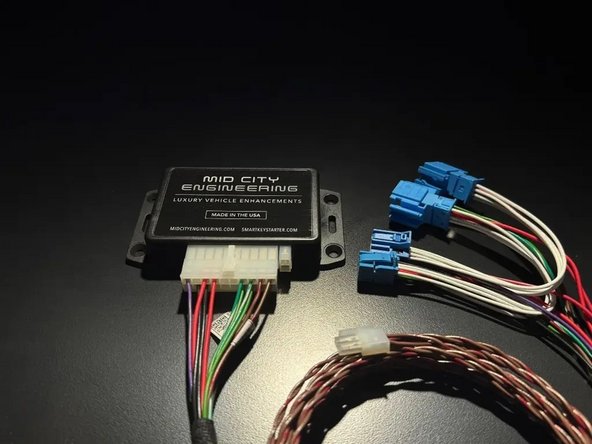
The SKSNG204D4 is a remote start and alarm interface for push to start/Keyless Go vehicles
Out of the box the remote start will working using the OEM key fob (1X press of the panic button or Lock-Unlock-Lock, if no panic button on key)
Vehicle Compatibility:
Push to Start
- CLS 2015-2019
- E Class Sedan, Coupe, and Wagon 2014-2016
- SLC 2016-2019
The SKSNG204D4 is compatible with the following add-ons:
- Any current Compustar Drone Smart Phone Control (X1, X2, LTE, MAX, XC)
- Compustar DAS II digital sensor for shock, tilt, glass break, and tow sensing (uses OEM horn for alarm)
- Compustar RF antenna and remotes (NON-AM remotes only, AM remotes NOT compatible)
- Directed Smart Start
- Compustar external remote start + alarm brain (eg, CM900, CMX)
The installation to the vehicle involves the following:
- EIS jumper modification
- T-harness connection behind the EIS (electronic ignition switch)
- Keyless Go jumper harness
- Key box installation (extra key required for installation)
- Optional accessories and add-ons
There is no flashing required for this installation, but options settings can be programmed using the instrument cluster menu. See user's manual (link below) for options settings. Please go through menu to make sure settings such as run time are set to preferred setting.
DO NOT MOUNT THE MODULE NEAR ANY HEAT SOURCES IN THE VEHICLE. SPECIFIC LOCATIONS TO AVOID ARE THE HEATER CORE ANDTHE TRANSMISSION TUNNEL
See end of guide for troubleshooting error codes
Tools
No tools specified.
Parts

-
-
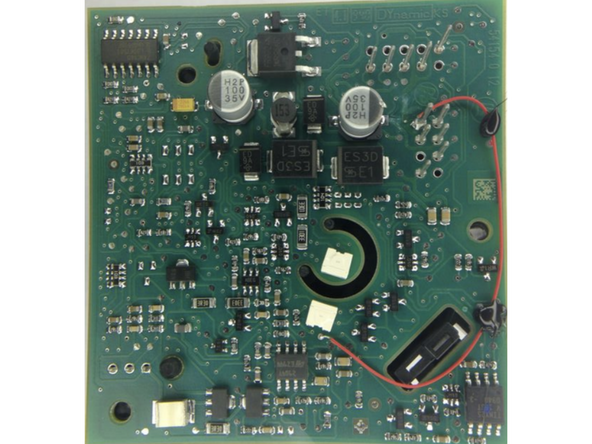
The EIS (electronic ignition switch) must be disconnected from the OEM harnessing and removed from the dash so that the EIS jumper pin and wire can be installed.
-
-
-
-
Inside the key box, there is a small plastic bag with a pin, length of thin wire, and a cap
-
Be sure to click here and read the step by step EIS modification instructions in full before attempting EIS modification and watch EIS modification demo video
-
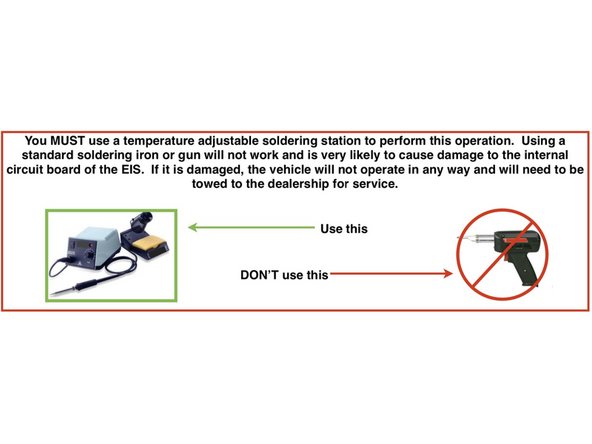
Make sure that you are using the correct soldering equipment detailed in the EIS modification instructions. If incorrect equipment is used the EIS could be damaged. Board level soldering is required.
-
Remove EIS board from case
-
Insert pin and solder to pin 8
-
Attach wire to pin
-
Solder wire to the solder point next to white optical sensor
-
Test EIS mod using continuity test
-
-
-
After EIS jumper is installed and EIS is reassembled, connect the EIS to the OEM harnessing and start vehicle with push to start and make sure that vehicle starts, runs, and operates normally and free from any errors before moving to the next step.
-
-
-
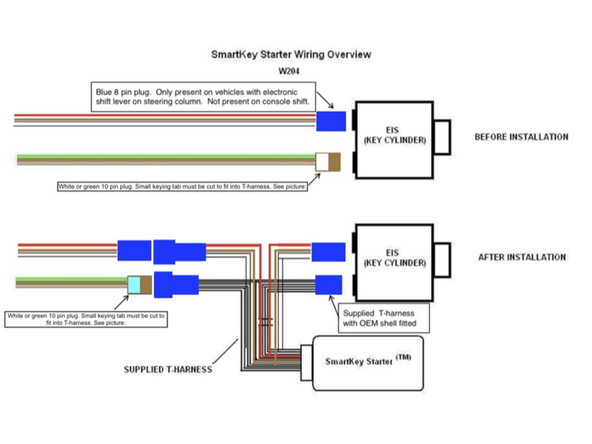
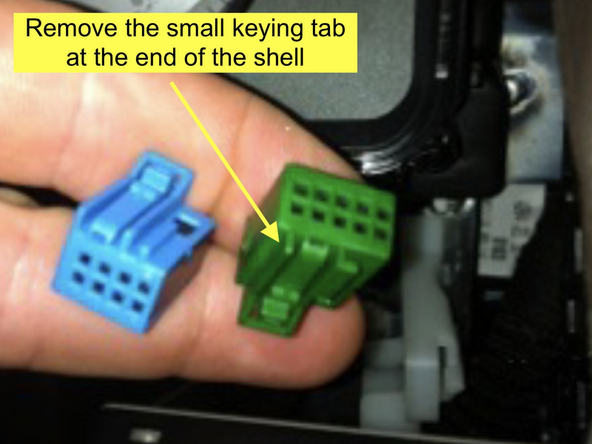
The 10-pin green or white connector will need to be modified slightly to fit into the T-harness. See pictures.
-
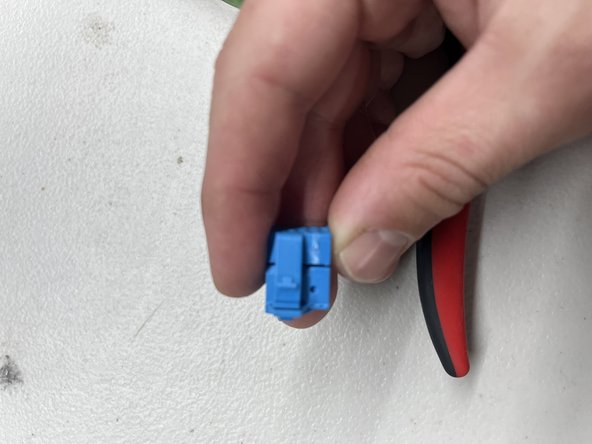
There is a small keying tab on the top of the connector. Using a small cutting tool, carefully cut off the keying tab flush with the shell of the connector. See pictures.
-
Plug the modified blue or green 10-pin plug into the blue male 10-pin plug on the SKS T-harness
-
Unplug the blue 8-pin connector from rear of EIS
-
Plug blue 8-pin plug into the male 8-pin blue plug on the SKS T-harness
-
Connect female blue 10-pin from T-harness to rear of EIS where green or white plug was removed
-
If there is a keying tab in the way on the SmartKey Starter® T-harness 10-pin plug, it is OK to remove that tab as was done on OEM plug
-
Connect blue female 8-pin connector from T-harness to rear of EIS where blue 8-pin factory plug was removed.
-
-
-
Start vehicle manually to verify vehicle is operating correctly and free from errors
-
If the vehicle does not start, check T-harness connections and make sure that module is plugged in. Verify that LEDs on SmartKey Starter module are on
-
-
-
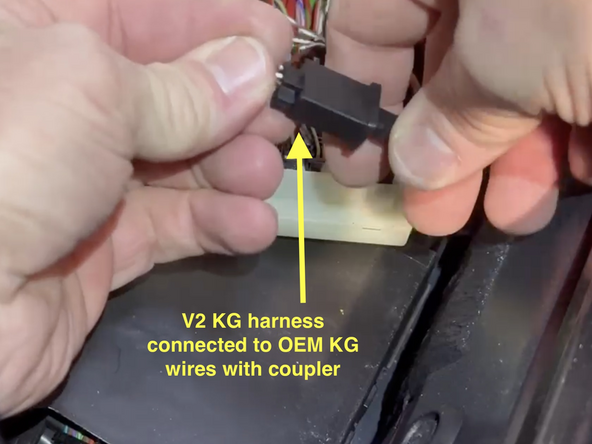
The SKSNG204D4 has a harness with twisted brown and brown/red wires terminating to a white 2-pin plug on one end and a black 2-pin plug on the other end (KG harness). These are for the Keyless Go connection.
-
The KG harness must be run from the SmartKey Starter® module to the specified CAN distribution block. At the distribution block there is a set of wires from the OEM Keyless Go module. A short test will be used to find the correct set of wires.
-
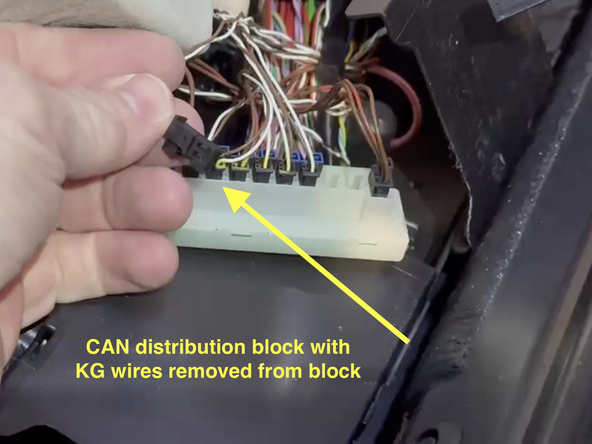
When the correct set of wires is located, those wires will be removed from the block and connected to the SmartKey Starter® module using the provided KG jumper harness. The distribution block will be bypassed.
-
The black 2-pin plug on the KG harness will either have:
-
A) 2-pin black plug on other end with a 2-pin female adapter plugged into the end. This is our V1 KG harness. If you have the V1 KG harness, the OEM wires get removed from the OEM plug & pinned into the adapter plug.
-
B) a 2-pin male plug with a coupler. This is our V2 KG harness. If you have the V2 harness, you will not need to re-pin the OEM wires. When the correct plug from the block is located, plug it into the end of the KG harness.
-
-
-
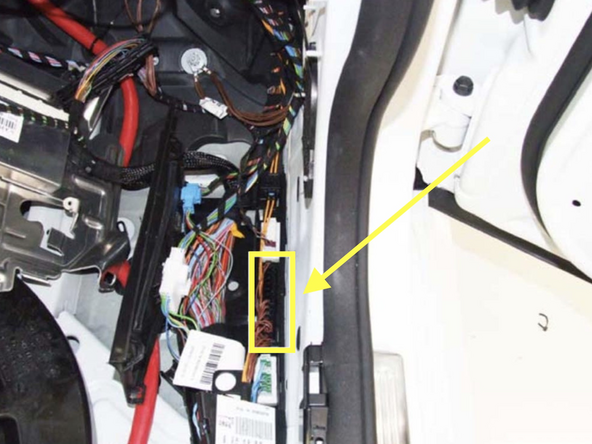
Locate the CAN distribution block where the KG wires are located. The block location depends on the chassis model and year.
-
E Class (Sedan & Wagon), 2014-2016: front passenger side, under the floor, along the door sill, towards the kick panel.
-
E Class (Coupe& Convertible), 2014-2016: front driver side, under the floor, along the door sill, towards the kick panel (pictured).
-
CLS, 2015-2019: front driver side, under the floor, along the door sill, towards the kick panel (pictured)
-
SLC, 2016-2019: front passenger side, under the floor, along the door sill, towards the kick panel (pictured)
-
-
-
To locate the wires in the distribution block that will be removed from the block and connected to the supplied harness, a short test will be used using the LEDs on the SmartKey Starter module
-
Connect provided KG harness to 2-pin white plug on SmartKey Starter module labeled KG and remove push to start button
-
Insert key in ignition and turn to ACC. FIRST position (one click)
-
Yellow LED on SmartKey Starter module will flash. Red LED will also flash.
-
Remove the OEM connectors from the distribution block one at a time and observe LEDs
-
Identify which plug, when unplugged from the block, cause the yellow LED to stop flashing (either solid off or solid on) but the red LED stays on
-
It may take up to 10 seconds for the LEDs to respond
-
Connect the plug that caused the yellow LED to stop flashing to the provided Keyless Go harness. Check LEDs on SKS module. Green and red LEDs on module should be flashing (with key in ACC), indicating communication with KG module. If green LED is not flashing, check connections and retest.
-
-
-
An extra key is required and will be installed with the SmartKey Starter.
-
Remove the metal key blade from the key being used for the install
-
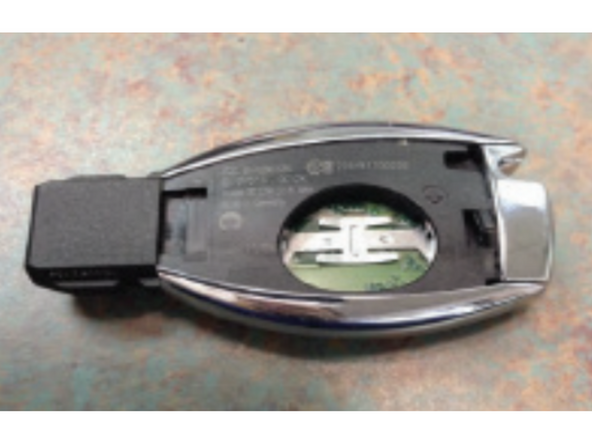
Remove the battery cover using the flat blade screwdriver by pressing on the tab inside the key
-
Remove the battery from the key
-
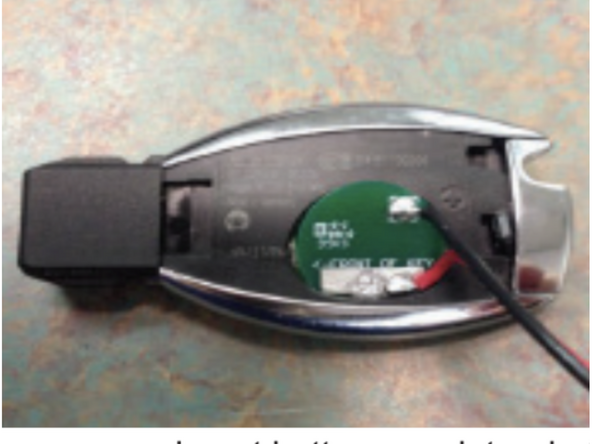
Insert the battery emulator with the arrow facing the tip of the key by angling the positive side down into the key first
-
Push the battery emulator fully into the battery slot
-
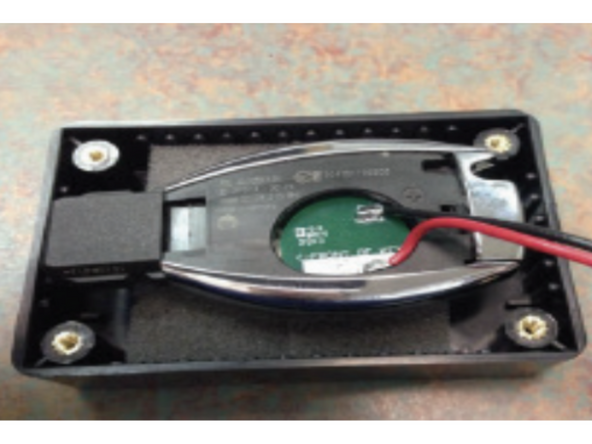
Insert the key into the key box with the buttons facing down on the foam
-
Put the lid on the box and secure it with the four (4) screws provided using a #1 Philips
-
-
-
Plug 2-pin white plug from key box into white 2-pin port labeled KEY on the SmartKey Starter module
-
-
-
Make sure that push to start button is inserted in the EIS. If button is not in the ignition, the remote start will not work and it will produce error code 9 (9 parking light flashes)
-
Attempt to remote start by pressing the panic button 1X on the OEM key fob
-
If the vehicle is not equipped with a panic button, use LOCK-UNLOCK-LOCK sequence from OEM fob to remote start
-
Vehicle should remote start
-
If remote start fails, count the number of parking light flashes to determine the error code. The parking lights will flash between 4X and 10X (this is the error code) and may be followed by a short pause and then 3X flashes for shutdown. The first set of flashes determines the error code. See bottom of guide for troubleshooting error codes.
-
Vehicle can be shut down from the OEM key by either pressing the panic button or LOCK-UNLOCK-LOCK command
-
-
-
Remote start vehicle. Once vehicle is started, to perform key takeover press the push to start button 1X (without your foot on the brake)
-
Parking lights will flash 3X and vehicle can be shifted into gear
-
-
-
Remote start vehicle
-
Once vehicle has remote started, press the brake pedal and confirm that vehicle shuts down
-
-
-
Open hood
-
Attempt remote start. Remote start should fail and produce error code 7 (7 parking light flashes)
-
-
-
Remote start vehicle
-
While vehicle is running under remote start, make sure that you can lock and unlock the door using the outside door handle (Keyless Go) with the key on your person
-
-
-
Compustar Drone: Connect to the GRAY 4-Pin port labeled DRONE on the SmartKey Starter module.
-
Directed Smart Start: Connect 4-pin D2D cable from Smart Start to white 4-pin port labeled D2D on the SmartKey Starter module. Cut and insulate blue and green data wires (leaving only black and red for power and ground.
-
Connect 3-pin ESP plug from Smart Start to 3-pin white plug on SmartKey Starter labeled Smart Start. Do not ground gray wire from Smart Start.
-
Compustar DAS II sensor: Connect to 4-pin RED port labeled SENSOR on the SmartKey Starter module
-
Compustar RF remotes: Connect Compustar antenna to 4-pin BLUE port on the SmartKey Starter module labeled 4PANT
-
AM remotes are NOT supported
-
Compustar remote programming: Cycle key from off to ignition 5X- parking lights will flash 1X after the 5th cycle. After the 5th cycle, press the button on the antenna (if antenna has a button) and press LOCK on each Compustar remote. Parking lights will flash when each remote is paired. Parking lights will flash 2X when exiting programming
-
-
-
Directed RF remotes: to add Directed remotes, a Directed XL202 RF to data converter must be used. Connect the XL202 to the 4 pin white plug labeled D2D on the SmartKey Starter module. Connect Directed RF antenna to XL202 and follow XL202 programming instructions
-
Compustar Alarm/Remote start module: an external alarm can be added using a Compustar Alarm/RS module (CM900, CMX, etc). To connect alarm use a RS232 cable. Plug one end of RS232 cable into BLACK port on CM and other end of RS232 cable into GRAY 4 pin port labeled DRONE on SmartKey Starter module
-
RS232 cable must have blue and white (RX and TX) wires reversed on one end of the cable. For example, if blue wire is in the outside pin position on one connector, it must be in the inside pin on the other side of the cable.
-
Connect power, ground, and ignition (with diode) wires from low current harness of Compustar CM. Constant power and ground can be wired to the SmartKey Starter T-harness
-
12V ignition wire must have diode installed with stripe facing the Compustar CM module
-
Connect all accessories to CM module
-
Compustar KeyLocker and KP2: A KP2 Compustar touchpad can be connected using either a Compustar CM or a KeyLocker module. Connect KeyLocker to GRAY port labeled DRONE
-
-
-
Locate a place to secure the Smartkey Starter module and key box
-
DO NOT mount the module on or near any heat sources or moving parts (eg, vents or steering column)
-
Secure the module in its final location using zip ties
-
-
-
Reassemble dash and any panels removed running wires
-
The provided warning sticker must be installed in this location or your SmartKey Starter® warranty will be voided
-
Install provided warning sticker on intermediate panel covering OBD II plug access. The purpose of the sticker is to inform anyone working on the vehicle that the vehicle is equipped with a remote starter
-
Remote starter must be turned off (valet mode) any time the vehicle is being serviced or undergoing any diagnostic tests or parked in a location where it is not safe for the vehicle to start
-
Troubleshooting:
If vehicle receives the command, but fails to remote start, the parking lights will flash a # of times. The number of parking light flashes corresponds to an error code. To troubleshoot no remote start count the number of parking light flashes.
Note: after a brief pause, the error code may be followed by a shutdown sequence of 3X flashes after the initial code
Error codes:
4 Flashes: Valet mode. The remote start is in valet mode (remote start off). Click here for valet mode instructions using the instrument cluster menu.
5 Flashes: Wrong variant. Power cycle modules and try again.
6 Flashes: Brake depressed. The vehicle sees that the brake is depressed. If the brake pedal is not pressed down, it is possible that the brake switch is out of alignment. Check brake switch above brake pedal. If brake switch is out of alignment, you may see brake lights on all the time when the vehicle is started.
7 Flashes: Hood open. The remote start will not work if the hood is open or latch is not fully closed.
8 Flashes: RPM overrev. Vehicle sees that RPM is too high.
9 Flashes: Not seeing the key or the button push.
Make sure that the push to start button is in the ignition.
Press the unlock button on the OEM key fob and then try to remote start- if it remote starts, check that the Keyless Go harness connections are done properly.
Sit inside the vehicle with the key on your person and attempt to remote start. If the remote start works with a working key inside the vehicle, there is an issue with the key in the box or the connection to the key in the box.
If vehicle still does not remote start from inside the vehicle with a working key and after pressing unlock on key, check EIS mod.
10 Flashes: Communication error. Check connections and power cycle module.
Troubleshooting:
If vehicle receives the command, but fails to remote start, the parking lights will flash a # of times. The number of parking light flashes corresponds to an error code. To troubleshoot no remote start count the number of parking light flashes.
Note: after a brief pause, the error code may be followed by a shutdown sequence of 3X flashes after the initial code
Error codes:
4 Flashes: Valet mode. The remote start is in valet mode (remote start off). Click here for valet mode instructions using the instrument cluster menu.
5 Flashes: Wrong variant. Power cycle modules and try again.
6 Flashes: Brake depressed. The vehicle sees that the brake is depressed. If the brake pedal is not pressed down, it is possible that the brake switch is out of alignment. Check brake switch above brake pedal. If brake switch is out of alignment, you may see brake lights on all the time when the vehicle is started.
7 Flashes: Hood open. The remote start will not work if the hood is open or latch is not fully closed.
8 Flashes: RPM overrev. Vehicle sees that RPM is too high.
9 Flashes: Not seeing the key or the button push.
Make sure that the push to start button is in the ignition.
Press the unlock button on the OEM key fob and then try to remote start- if it remote starts, check that the Keyless Go harness connections are done properly.
Sit inside the vehicle with the key on your person and attempt to remote start. If the remote start works with a working key inside the vehicle, there is an issue with the key in the box or the connection to the key in the box.
If vehicle still does not remote start from inside the vehicle with a working key and after pressing unlock on key, check EIS mod.
10 Flashes: Communication error. Check connections and power cycle module.
