Introduction
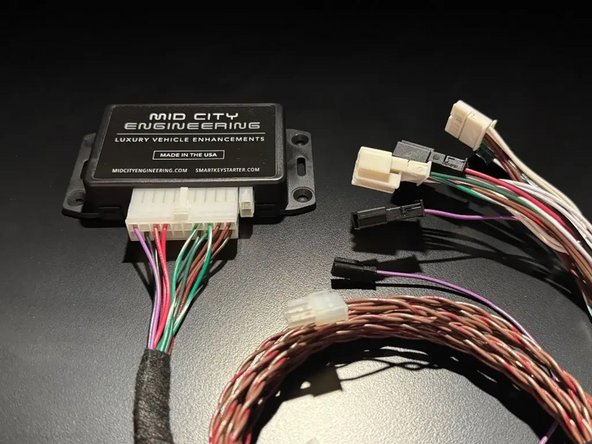
The SKSNG231D4 is a remote start and alarm interface.
Out of the box the remote start will working using the OEM key fob (1X press of the panic button or Lock-Unlock-Lock, if no panic button on key)
Vehicle Compatibility:
- SL 2013-2020
The SKSNG231D4 is compatible with the following add-ons:
- Any current Compustar Drone Smart Phone Control (X1, X2, LTE, MAX, XC)
- Compustar DAS II digital sensor for shock, tilt, glass break, and tow sensing (uses OEM horn for alarm)
- Compustar RF antenna and remotes (NON-AM remotes only, AM remotes NOT compatible)
- Directed Smart Start
- Compustar external remote start + alarm brain (eg, CM900, CMX). Note: RS232 4-pin to 4-pin data cable with RX and TX reversed on one end required for external alarm
- Compustar KeyLocker
- Compustar KP2 touch pad (KeyLocker required)
The installation to the vehicle involves the following:
- EIS modification
- T-harness connection behind the EIS (electronic ignition switch)
- Key box connection (extra key required for installation)
- Keyless Go jumper harness
- Optional accessories and add-ons
Note: There is a mating black connector on the SKSNG231D4 T-harness. DO NOT connect that connector until all other connections at the EIS are made. Only the short end of the wire should be connected to EIS after modification (steps 5-6).
There is no flashing required for this installation, but options settings can be programmed using the instrument cluster menu. See user's manual (link below) for options settings. Please go through menu to make sure settings such as run time are set to preferred setting.
DO NOT MOUNT THE MODULE NEAR ANY HEAT SOURCES IN THE VEHICLE. SPECIFIC LOCATIONS TO AVOID ARE THE HEATER CORE ANDTHE TRANSMISSION TUNNEL
See end of guide for troubleshooting error codes
Tools
No tools specified.
Parts

-
-
Remove rear center trim panel located behind the driver's seat between the back of the center console and the rear wall of the cabin, just below the folding roof compartment
-
Remove long trim piece located on passenger side of console
-
-
-
Remove trim around radio and pull radio console out
-
Remove push to start button
-
Release EIS (electronic ignition switch) from dash and remove from dash
-
The EIS is held into the dash by 2X clips- 1X on the top and 1X on the bottom of the module. To release from dash, squeeze the tabs towards the middle of the cylinder and pull away from dash panel
-
-
-
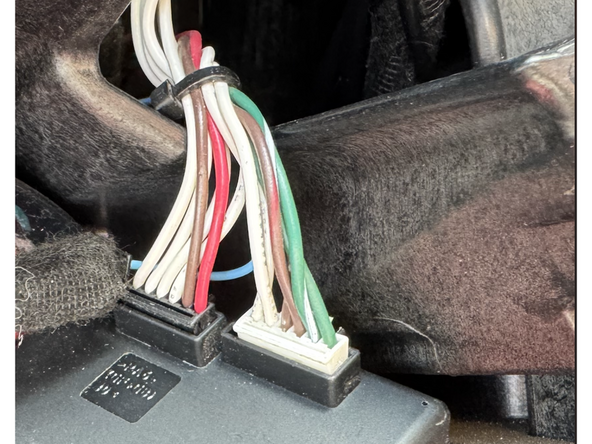
The ignition switch (EIS) will have a 6-pin white plug and 1X 6-pin black plug connected. Unplug both from the EIS so that EIS is completely disconnected from the vehicle
-
-
-
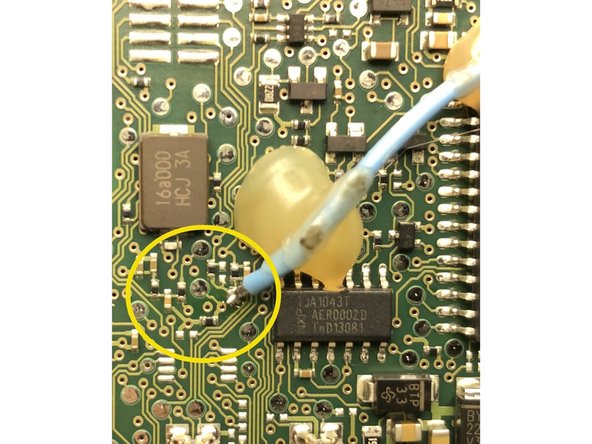
The next step involves soldering a wire onto the board of the EIS. Experience with circuit board level soldering is required.
-
If you would like to send in the EIS for modification, Mid City will perform this service included with the purchase of the SmartKey Starter®. Please call Mid City Engineering at 312-421-1114 ext. 1 or email sales@midcityengineering.com
-
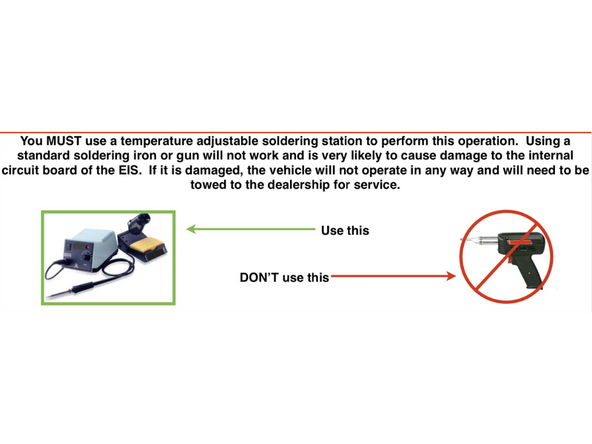
A stationary, temperature controlled stationary soldering tool is required for this modification. See image for example.
-
Recommended soldering temperature is 750 degrees Fahrenheit. DO NOT OVERHEAT.
-
THE EIS HAS COMPONENTS THAT ARE STATIC SENSITIVE- BE SURE TO USE PROPER GROUNDING TECHNIQUES WHILE WORKING ON THE EIS.
-
-
-
Remove screws from EIS case and open to expose board
-
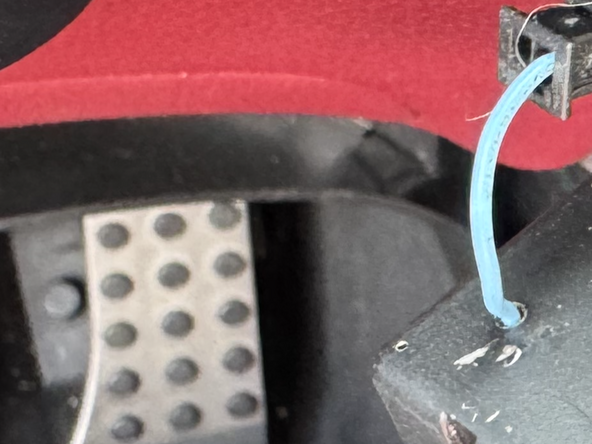
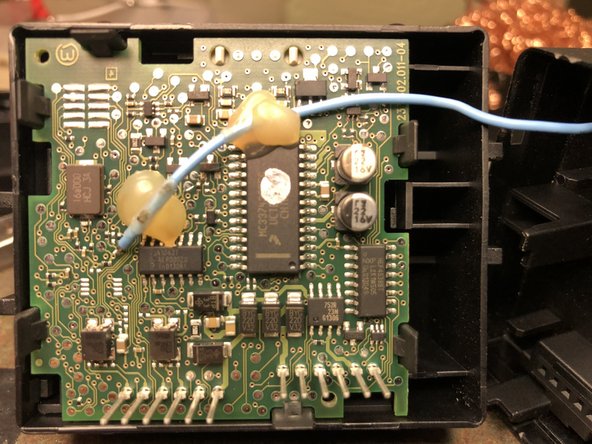
Drill small hole in the corner of the EIS case as shown in the picture
-
Run bare end of blue wire through that hole and prepare for soldering to EIS board
-
-
-
Included with the kit is a short blue wire with a black plug. The bare end of that wire will be soldered to the board of the EIS
-
Note: there is a mating black connector on the SKSNG231D4 T-harness. DO NOT connect that connector until all other connections at the EIS are made. Only the short end of the wire should be connected to EIS after modification.
-
Solder blue wire to spot on EIS as shown on picture
-
DO NOT OVERHEAT
-
THE EIS HAS COMPONENTS THAT ARE STATIC SENSITIVE- BE SURE TO USE PROPER GROUNDING TECHNIQUES WHILE WORKING ON THE EIS.
-
Reassemble EIS case and check that blue wire is securely connected and run through hole in case
-
-
-
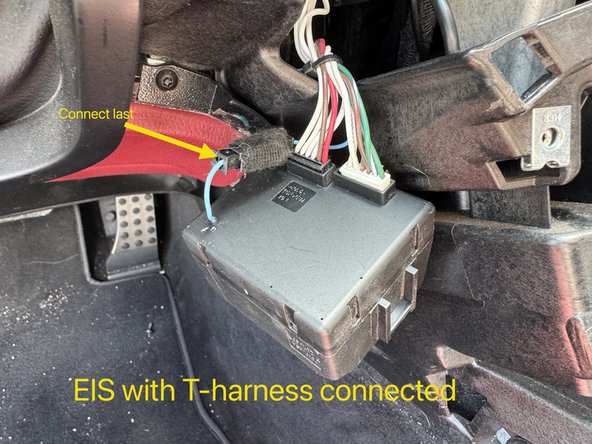
Do not connect blue wire from EIS to T-harness. Doing so before EIS harnessing and SmartKey Starter module are connected could damage EIS. There is a tag on the blue wire of the T-harness that says connect last
-
Connect white 6-pin plug from provided T-harness to mating white 6-pin from chassis harness
-
Connect black 6-pin harness from T-harness to mating black 6-pin from chassis harness
-
Connect black 6-pin receptacle from T-harness to mating plug on EIS
-
Connect white 6-pin receptacle from T-harness to mating plug on EIS
-
Make sure that white 20-pin plug from T-harness is connected to white 20-pin on SmartKey Starter module (main connector).
-
Only after all above connections are made and module is plugged in, plug black connector with blue wire from T-harness to black receptacle with blue wire from EIS
-
-
-
Start vehicle with push to start button and make sure that vehicle is operating normally
-
-
-
Included with the kit is a twisted pair of brown and brown/red wires with a black 2-pin plug and a white 2-pin plug (KG harness). This harness will be connected to a set of wires located at the distribution block under the driver side dash with brown and brown/red OEM wires.
-
Locate distribution block (row of connectors) in driver side under dash with brown and brown/red OEM wires
-
Connect white 2-pin plug from KG harness to white 2-pin plug on SmartKey Starter module labeled KG
-
Remove push to start button, insert key and turn key to first (ACC) position
-
Red and yellow LEDs on SmartKey Starter module will begin to flash
-
Start to remove plugs from the distribution block one at a time and check the LEDs. Continue this test until you find the plug that makes only the yellow LED turn off or stop flashing
-
Connect the plug that made just the yellow LED stop flashing to the mating plug on the KG harness. After making connection, check LEDs- the red and green LEDs should now be flashing. If the red and green LEDs are not flashing, the KG connection is incorrect.
-
-
-
To test remote start press the panic button on the OEM fob with the vehicle off. Vehicle should start.
-
If OEM fob does not have a panic button, the system will default to ‘LOCK-UNLOCK-LOCK’ operation from key fob
-
To perform key takeover, press the push to start button 1X while remote started. If the key is present, the parking lights will flash 3X and the vehicle can be shifted into gear
-
-
-
Open vehicle hood and attempt remote start. Vehicle should not start and parking lights should flash 7X, indicating hood open error
-
-
-
Remote start vehicle and make sure that Keyless Go lock and unlock functions for outside door handle are operating correctly while vehicle is in a remote start state.
-
-
-
Compustar Drone: Connect to the GRAY 4-pin port labeled DRONE on the SmartKey Starter module.
-
Directed Smart Start: Connect 4-pin D2D cable from Smart Start to white 4-pin port labeled D2D on the SmartKey Starter module. Cut and insulate blue and green data wires (leaving only black and red for power and ground.
-
Connect 3-pin ESP plug from Smart Start to 3-pin white plug on SmartKey Starter labeled Smart Start. Do not ground gray wire from Smart Start.
-
Compustar DAS II sensor: Connect to 4-pin RED port labeled SENSOR on the SmartKey Starter module
-
Compustar RF remotes: Connect Compustar antenna to 4-pin BLUE port on the SmartKey Starter module labeled 4PANT
-
AM remotes are NOT supported
-
Compustar remote programming: Cycle key from off to ignition 5X- parking lights will flash 1X after the 5th cycle. After the 5th cycle, press the button on the antenna (if antenna has a button) and press LOCK on each Compustar remote. Parking lights will flash when each remote is paired. Parking lights will flash 2X when exiting programming
-
-
-
Directed RF remotes: to add Directed remotes, a Directed XL202 RF to data converter must be used. Connect the XL202 to the 4 pin white plug labeled D2D on the SmartKey Starter module. Connect Directed RF antenna to XL202 and follow XL202 programming instructions
-
Compustar Alarm/Remote start module: an external alarm can be added using a Compustar Alarm/RS module (CM900, CMX, etc). To connect alarm use a RS232 cable. Plug one end of RS232 cable into BLACK port on CM7000 and other end of RS232 cable into GRAY 4 pin port labeled DRONE on SmartKey Starter module
-
RS232 cable must have blue and white (RX and TX) wires reversed on one end of the cable. For example, if blue wire is in the outside pin position on one connector, it must be in the inside pin on the other side of the cable.
-
Connect power, ground, and ignition wire from low current harness of Compustar CM. Constant power and ground can be wired to the SmartKey Starter T-harness
-
Connect all accessories into Compustar CM
-
Compustar KeyLocker and KP2: A KP2 Compustar touchpad can be connected using either a Compustar CM or a KeyLocker module. Connect KeyLocker to GRAY port labeled DRONE
-
-
-
Locate a place to secure the Smartkey Starter module and key box
-
DO NOT mount the module on or near any heat sources or moving parts (eg, vents or steering column)
-
Secure the module in its final location. Zip ties are recommended.
-
-
-
Reassemble dash and any panels removed running wires
-
The provided warning sticker must be installed in this location or your SmartKey Starter® warranty will be voided
-
Install provided warning sticker on intermediate panel covering OBD II plug access. The purpose of the sticker is to inform anyone working on the vehicle that the vehicle is equipped with a remote starter
-
Remote starter must be turned off (valet mode) any time the vehicle is being serviced or undergoing any diagnostic tests or parked in a location where it is not safe for the vehicle to start.
-
-
-
Use instrument cluster menu to check options settings (run time, light flash, etc) to make sure settings are to preference. See user's manual for instrument cluster menu instructions: Click Here for User's Manual
-


Troubleshooting:
If vehicle receives the command, but fails to remote start, the parking lights will flash a # of times. The number of parking light flashes corresponds to an error code. To troubleshoot no remote start count the number of parking light flashes.
Note: after a brief pause, the error code may be followed by a shutdown sequence of 3X flashes after the initial code
Error codes:
4 Flashes: Valet mode. The remote start is in valet mode (remote start off). Click here for valet mode instructions using the instrument cluster menu.
5 Flashes: Wrong variant. Power cycle modules and try again.
6 Flashes: Brake depressed. The vehicle sees that the brake is depressed. If the brake pedal is not pressed down, it is possible that the brake switch is out of alignment. Check brake switch above brake pedal. If brake switch is out of alignment, you may see brake lights on all the time when the vehicle is started.
7 Flashes: Hood open. The remote start will not work if the hood is open or latch is not fully closed.
8 Flashes: RPM overrev. Vehicle sees that RPM is too high.
9 Flashes: Not seeing the key or the button push.
Make sure that the push to start button is in the ignition.
Press the unlock button on the OEM key fob and then try to remote start- if it remote starts, check that the Keyless Go harness connections are done properly.
Sit inside the vehicle with the key on your person and attempt to remote start. If the remote start works with a working key inside the vehicle, there is an issue with the key in the box or the connection to the key in the box.
If vehicle still does not remote start from inside the vehicle with a working key and after pressing unlock on key, check EIS mod.
10 Flashes: Communication error. Check connections and power cycle module.
Troubleshooting:
If vehicle receives the command, but fails to remote start, the parking lights will flash a # of times. The number of parking light flashes corresponds to an error code. To troubleshoot no remote start count the number of parking light flashes.
Note: after a brief pause, the error code may be followed by a shutdown sequence of 3X flashes after the initial code
Error codes:
4 Flashes: Valet mode. The remote start is in valet mode (remote start off). Click here for valet mode instructions using the instrument cluster menu.
5 Flashes: Wrong variant. Power cycle modules and try again.
6 Flashes: Brake depressed. The vehicle sees that the brake is depressed. If the brake pedal is not pressed down, it is possible that the brake switch is out of alignment. Check brake switch above brake pedal. If brake switch is out of alignment, you may see brake lights on all the time when the vehicle is started.
7 Flashes: Hood open. The remote start will not work if the hood is open or latch is not fully closed.
8 Flashes: RPM overrev. Vehicle sees that RPM is too high.
9 Flashes: Not seeing the key or the button push.
Make sure that the push to start button is in the ignition.
Press the unlock button on the OEM key fob and then try to remote start- if it remote starts, check that the Keyless Go harness connections are done properly.
Sit inside the vehicle with the key on your person and attempt to remote start. If the remote start works with a working key inside the vehicle, there is an issue with the key in the box or the connection to the key in the box.
If vehicle still does not remote start from inside the vehicle with a working key and after pressing unlock on key, check EIS mod.
10 Flashes: Communication error. Check connections and power cycle module.
